
Example conversationScripted
Is this home still available?
Hi, I'm Sarah, an AI assistant. Yes. What's your budget?
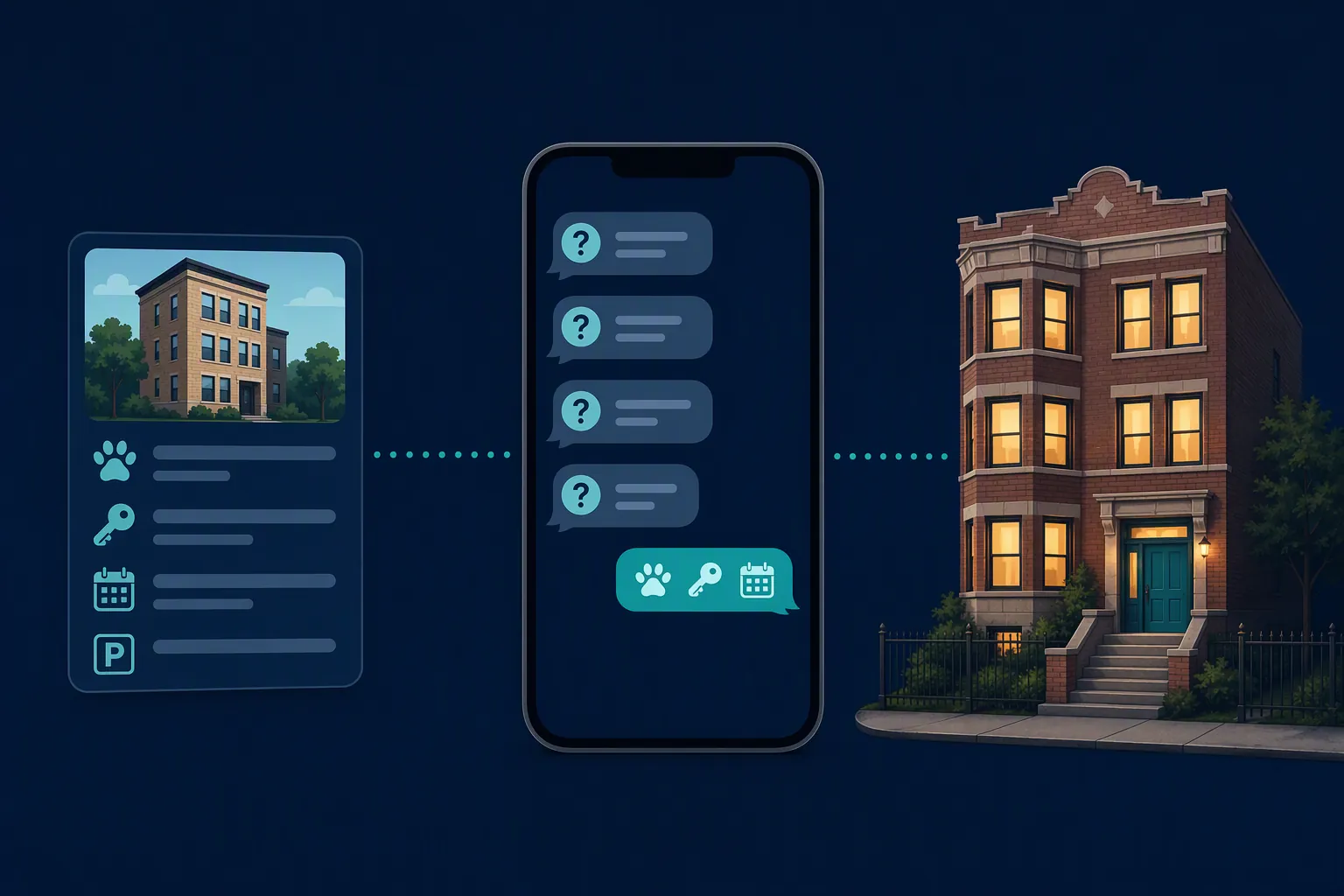
"Is it pet friendly?" "When is it available?" "Is parking included?" "What's the income requirement?"
If you have a rental on the market, you have answered these questions many times this week. Often the answer is already in the listing, sometimes in the first line.
This guide is for landlords, property managers, and leasing agents. It covers why repeat questions cost more than the minute each one takes, a simple reply pattern you can use for every renter, and the few questions that should never get a canned answer.
In a BiggerPockets thread on responding to rental inquiries, an investor in California explained that he puts all of his rental requirements (income at 3x the rent, a minimum credit score, no evictions) and all of the property details in the listing. He wrote that it covers "99% of the info a tenant would need... but I still get asked the same questions." His fix: a canned reply pointing back to the listing and to his next group open house.
Another landlord, in a thread about handling prospects only by text and email, described a renter asking whether no pets was a firm rule, even though, in his words, it was "the very first, middle and last line of the listing."
That's two landlords, not a survey. But anyone who has run a rental listing will recognize it. A renter texting from a phone, maybe while comparing several units, may simply find it faster to ask than to scroll back.
Each question takes a minute. The bigger problem is what happens to the answers when you type them from memory between showings, on the train, or late at night.
A July 2026 post from PropertySea, a landlord software company, puts it plainly: if two leads ask the same question, the answer should sound the same except for scheduling details. It recommends keeping a standard response sheet with your baseline criteria and answering from that sheet every time.
Consistency is also a fair housing issue, not just a customer service one. The City of Chicago's Fair Housing FAQ lists applying different terms and conditions to the rental of housing among the forms housing discrimination can take. When every renter gets the same facts, from the same sheet, you are in a much better position.
Use the same three parts every time.
1. Answer the question they asked, from your listing facts. Short and direct. If they asked about pets, answer the pet question first.
2. Add the two or three facts that decide most showings. Usually the available date, the rent, and anything renters often miss (for example, the pet policy or parking). Use the same facts and the same words for everyone who asks about that unit.
3. End with a next step. Offer two showing times, or ask one or two quick questions before booking. In a later reply in the same BiggerPockets thread, another landlord said every interested person follows exactly the same process and answers exactly the same basic questions before requesting a viewing.
Here's an example for a renter who asks, "Do you allow dogs?" about a two-bedroom:
Renter: Hi, do you allow dogs?
Reply: Thanks for asking! This 2-bedroom allows one dog under 40 lbs, with a $35/month pet fee. It's available November 1 at $2,150/month, and street parking only. I can show it Thursday at 6:00 PM or Saturday at 11:00 AM. Would either work? If you have an assistance animal, let me know and I'll follow up personally.
(Example only. The unit, numbers and policy are made up.)
If the same question keeps coming in, move that answer higher in the listing. The goal isn't to scold renters for not reading. It's to make the answer impossible to miss and to give the same reply when they ask anyway.
Before the listing goes live, write down one answer for each common question. Keep it next to the listing so whoever replies (you, a teammate, or an assistant) uses the same words.
Don't add opinions about the neighborhood or who it's a good fit for. Describe the unit, the building, and the terms. That keeps answers factual and avoids steering, which the Chicago FAQ also lists as a form of housing discrimination.
Most repeat questions are fine to answer from the sheet. A few need a person.
"Is the no-pets rule firm? It's a service animal." In the second BiggerPockets thread, a broker warned the landlord that once the renter said the animal was a service dog, he was legally obligated to respond. Chicago's Fair Housing FAQ says people with disabilities may request reasonable accommodations to rules and policies, "such as allowing service or support animals regardless of a 'no pet' rule." Don't answer an accommodation request with your pet policy. Hand it to whoever handles accommodation requests and follow your written process.
"Do you take vouchers?" In Chicago, lawful source of income, including a Section 8 Housing Choice Voucher, is a protected class under the city's Fair Housing Ordinance, according to the same FAQ. Your answer should be the same yes for every renter. Our guide to pre-screening Chicago renters by text covers the source-of-income rules for Chicago and Cook County in more detail.
Anything about who lives nearby, or who the unit is "good for." Stick to facts about the unit and the terms. The Fair Housing Act protects against discrimination based on race, color, national origin, religion, sex, familial status, and disability (HUD overview). Chicago's ordinance adds more protected classes, including age, sexual orientation, gender identity, marital status, parental status, military status, and source of income.
This is general information, not legal advice. Talk to a lawyer about your specific policies.
Repeat questions are one part of the inquiry load. If you're still sorting out the rest:
Sarah AI is a 24/7 SMS assistant for Chicago real estate agents, small brokerages, property managers, and landlords. When a renter texts your listing number, Sarah:
Your Google Sheet works as the answer sheet: Sarah answers from the details you put there, so you update a fact once instead of retyping it in every thread. See how it works for landlords, property managers, and real estate agents, or read about Sarah in Chicago.
A renter texting from a phone, maybe while comparing several units, may find it faster to ask than to scroll back. One landlord on BiggerPockets said his listing covers "99% of the info a tenant would need" and he still gets the same questions. Plan for it: keep one saved answer per common question and move the most-asked answers higher in the listing.
You can point renters back to the listing, but a short direct answer plus a next step usually moves the conversation forward faster. Answer the question asked, add the two or three facts that decide most showings, and offer two showing times.
Use the same three parts every time: a direct answer to the question, the key facts for that unit (available date, rent, and anything renters often miss, like pets or parking), and a clear next step such as two showing times. Give every renter who asks about the same unit the same facts.
Don't reply with your pet policy. Chicago's Fair Housing FAQ says people with disabilities may request reasonable accommodations such as service or support animals regardless of a no-pet rule. Have a person handle the request and follow your written process. This is general information, not legal advice.
Yes. Sarah answers renters' texts using the listing details in your Google Sheet, asks the same qualifying questions every time, and offers showing times from your Google Calendar. You can take over any conversation from the agent dashboard.
Want to see Sarah answer a renter's questions from your listing details and book a showing? Book a demo. We'll walk through a renter's first text, the qualifying questions, a Google Sheet match, and a showing on Google Calendar.

Co-founder, NextGen Fusion AI
Free 2-week supervised pilot.
(844) 681-7964Sarah is AI. Reply STOP anytime.